
Why 30 minutes can be enough
The 30-minute session is often dismissed as a "sample" or "quick fix" but for the right goal it is the optimal session length. Focused work on shoulders, neck, and lower back — the three areas where most desk-work tension accumulates — does not require 60 minutes to be effective. A 30-minute Stress Relief session at $50 spends concentrated time on exactly the problem areas, often producing more relief than a generalized 60-minute session that distributes time across the whole body. The math is simple: targeted time beats spread time when the problem is targeted. Many of our after-work regulars switched to 30-minute sessions and reported equal or better results compared to their previous 60-minute habit.
The math of after-work timing
A typical 6 PM workday end leaves you with maybe 90 minutes before dinner, family time, or evening commitments. A 30-minute session takes about 50 minutes door-to-door including check-in and dressing. That fits comfortably into the 90-minute window with time to spare. A 60-minute session takes 80 minutes, which leaves only 10 minutes of buffer — too tight if traffic is bad or check-in takes longer. The 30-minute format is built for exactly this kind of tight after-work scenario. The flat-rate $50 versus $70 saves $20 per visit, which compounds over weekly or bi-weekly visits into meaningful annual savings.
Best after-work windows at our spa
The 6-8 PM weekday window is our second-busiest after Friday evening, so chat-ahead is helpful. The 8-10 PM weekday window is calmer and often has zero wait for walk-ins. Sunday evenings (5-9 PM) are moderate. The Monday-Thursday late evening windows (after 8 PM) are particularly good for guests who want to decompress before sleep without time pressure. If your work day ends at 6 PM, arriving at 6:30-7 PM during peak avoids both work-day rush hour and the 8 PM tapering effect. Send your usual after-work timing on the bottom right and we will tell you which window matches best.
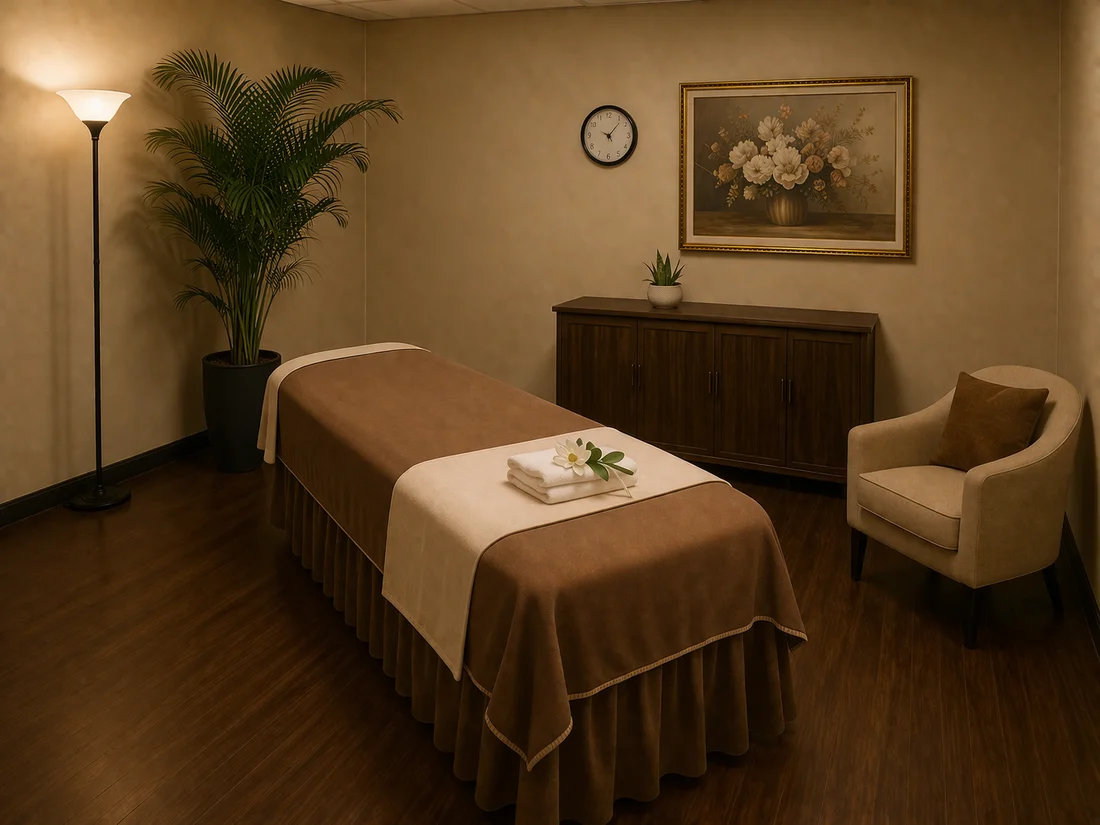
What 30 minutes of focused work looks like
After 2 minutes of check-in, you change in privacy and lie face-down. The therapist begins immediately on the upper trapezius and works down to the lower back over the first 12-15 minutes. The middle 8-10 minutes focus on whichever specific area you flagged at check-in (often the lower back or one specific shoulder). The final 5 minutes return to the upper area for finishing work and the base of skull. The pacing is faster than a 60-minute session — less warming time, more direct pressure work. The session ends with a clear sense that the work happened where it needed to happen.
How after-work massage affects the rest of the evening
Coming home with looser shoulders and a clearer head changes the rest of the evening. Family interactions are calmer because your nervous system is in a more relaxed state. Dinner is more enjoyable because the day's tension is not still pulling at you. Sleep onset is faster and sleep quality is better. Many guests describe the after-work massage as the missing transition between work-mode and home-mode — a small explicit decompression activity that prevents work stress from spilling into evening relationships. The compounding effect over weeks and months is real.
Who benefits most from the 30-minute after-work pattern
Desk workers with chronic upper-body tension. Drivers with lower-back tightness from commute traffic. Healthcare workers ending physical patient-care shifts. Restaurant industry workers ending stand-all-day shifts. Tech workers ending screen-staring days. Parents grabbing 50 minutes of solitude before family evening. Anyone whose stress shows up as muscle tension rather than emotional exhaustion. The pattern requires consistency — once-a-month visits give occasional relief; bi-weekly visits build sustained baseline reduction; weekly visits produce dramatic cumulative improvement. Pick the cadence that fits your budget and time.
Building 30-minute visits into your routine
The most successful after-work pattern combines three elements: a consistent day (e.g., every Tuesday), a consistent arrival window (e.g., 6:30 PM), and a consistent session type (e.g., 30-minute Stress Relief). Once these three are in place, the visit becomes habit rather than decision — you simply show up rather than re-deciding each week. Most regulars settle into this kind of pattern within 4-6 visits. We track regulars' usual times and try to keep the preferred therapist available. Send your usual day and time on the bottom right and we will note the preference in your file.
Comparing 30-minute weekly to 60-minute bi-weekly
Two equivalent-cost patterns: 30-minute weekly at $50 = four sessions per month for 2 hours of bodywork. 60-minute bi-weekly at $70 = two sessions per month for 2 hours of bodywork. Same time on the table; different visit frequency. The weekly pattern provides more frequent nervous-system reset and better suits high-stress periods. The bi-weekly pattern provides deeper per-session work and saves a meaningful amount over the year. Most regulars try both and settle on whichever fits their stress level and budget. The flat-rate model accommodates either choice without lock-in. Send your situation on the bottom right and we will recommend a starting pattern.
How after-work massage compares to other decompression options
Many San Diego workers use other after-work decompression options — happy hour drinks, gym workouts, yoga classes, screen-based entertainment. Each has trade-offs. Drinks decompress but cost downstream sleep quality. Workouts produce different but additive nervous-system load. Yoga is excellent but requires consistent attendance. Screen entertainment numbs but does not actually release tension. After-work massage uniquely addresses the physical-tension component of stress without downstream cost — you arrive home looser, more present, ready for the evening. The flat-rate $50 makes the math friendly compared to most alternatives.
Building the after-work pattern into your week
Making after-work massage a real habit takes a small amount of structure. The most reliable pattern we see in regulars: one fixed weekday slot that becomes non-negotiable, treated like a recurring meeting on the calendar. Tuesday at 6:30 PM, Wednesday at 7 PM, whatever fits your work rhythm. The other variable visits get scheduled around that anchor. Without the anchor, the after-work session becomes the first thing you cancel when work runs late or a friend invites you out. With the anchor, you protect it the way you would protect a doctor's appointment. The anchor day can vary by season — in summer when daylight stretches late, Wednesday works well. In winter when energy drops earlier, Tuesday or Thursday often fits better.
Pair the anchor with a simple cue. Many regulars send us a one-line message from their phone as they leave the office: "Heading over, ETA 6:35." That action — sending the message — is the commitment. Once it is sent, you go. The cue removes the in-between window where you might talk yourself out of it ("I'll just go home and do it Friday instead"). Friday rarely happens because by Friday you have weekend plans. The anchor pattern with a simple cue is what separates people who book one session every six weeks from people who actually feel the cumulative benefit of weekly maintenance.
Pairing 30-minute after-work with weekend longer sessions
The most effective pattern for busy professionals is not 30-minute weekly alone, and not 60-minute bi-weekly alone — it is a hybrid. One 30-minute Stress Relief mid-week as decompression, plus one 60-minute Swedish or Oil Relaxing on weekend mornings as a deeper reset. The 30-minute session keeps tension from accumulating across the week. The 60-minute session does the deeper work that the 30 cannot finish. Combined, this gives you a mid-week reset and a deeper weekend reset — roughly the cost of a typical San Diego restaurant dinner, with a much higher wellness return. The mid-week 30 prevents the weekend 60 from feeling like emergency repair, and the weekend 60 prevents the mid-week 30 from feeling like crisis management.
For people who cannot commit to that volume, the next best pattern is alternating: 30-minute one week, 60-minute the next. The lower-frequency version still beats nothing-then-emergency-session by a wide margin. The pattern we see fail most often is people who skip massage for two months, accumulate severe tension, then book one 90-minute session expecting it to undo two months of buildup. It does not — and they leave thinking massage does not work for them. Consistency at any cadence beats sporadic intensity. Send your schedule on the bottom right and we can suggest the pattern that fits your rhythm.
Tracking the after-work pattern over time
Keeping a simple log of how each after-work session affected your evening and next-day energy is a low-effort way to optimize the pattern. Note the day, session length, and a 1-10 score of how the rest of the evening felt. After 6-8 sessions you will see clear patterns — which weekday timing works best, whether 30 or 60 is right for your work intensity, and whether you bounce back faster from Stress Relief or Oil Relaxing. The data takes 30 seconds to capture per session and turns guesswork into informed scheduling. Many of our regulars settle on a fixed personal pattern within two months.
Frequently asked questions
Is 30 minutes really enough?
For focused work on shoulders, neck, lower back — yes. For full-body relaxation, choose 60-minute.
Can I do 30-minute sessions weekly?
Yes — the gentler pace makes weekly sustainable indefinitely.
Same flat rate for both?
$50 for a half-hour visit, $70 for 60 minutes. Save $20 per visit with the shorter format.
Best after-work day to come?
Tuesday or Wednesday — calmer than Friday, more recovery time before weekend than Thursday.
Should I shower before coming after work?
Not required — we provide all linens fresh. A quick shower at home after is a common pattern.
More posts
Come in for a session
We are at 7999 Dagget St A-12 with hours 8 AM through midnight, every day. Honest flat-rate pricing — $50 for a half-hour visit, $70 for 60 minutes — every visit.
Want a private room ready when you arrive? Send your arrival time on the bottom right →